Advocacy on Climate Change
Punarchith’s research and advocacy on climate change and its acute effect on the people of the Chamarajanagar region began in 2018/2019, with one of the most comprehensive data compilation projects on climate emergency issues for a single district in India. Secondary data related to changes in temperature, rainfall, soil conditions, evapotranspiration, water (especially ground water) availability, agriculture and cropping patterns, and drought frequency were compiled and broad overviews and future scenarios on the state of natural resources in the region and its impact on livelihoods and conditions of living were developed. Since, we have continued integrating local knowledge and widespread data on the changing climate that is overturning agricultural practices, and resulting in a severe loss of livelihoods in rural India, in all of our programs and as a module in the ILP. With the predictions on Super El Nino and drought years coming up, this topic remains a focus for us, and the broader rural and agrarian community in India.
Our advocacy has included presenting trends and impact of Climate Change to the District Administrators and to the State Institute of Rural Development in Mysuru, engaging Panchayat members on this matter, conducting sessions on climate change in 5 high schools and 2 colleges in the district, bringing community together to clean the small tank in the area, creating videos of the impact of climate change on local farmers, and increasing overall awareness via workshops on the signs of climate change, its impacts, and possible alternatives. However, we have faced steep challenges with public support in this field. In 2024/25 the Punarchith team along with two geologists (Keerthan and Manjunath) met with the village elders, women, youth, PDO, and local members to seek support for the Nagavalli Dodda Kere (large tank) restoration project. However, the expected level of support was not forthcoming from Nagavalli residents and the Panchayat members were expecting CSR funding to be arranged for such work.
Through our sessions at schools, and other workshops, we have developed a ‘tool kit’ to assess climate change that can be used in various pedagogic transactions. Broadly, this includes an overview of the reasons for climate change, details of trends in the district and an activity-based exercise in which participants/users can assess the ecological conditions in their own villages and settlements. We also had Nagraj Adve’s small booklet on climate change translated into Kannada (by K.P.Suresh) and it was published as a Punarchith publication. We have distributed copies of this booklet during our varied training programs and some of it has been sold by the publisher.
Given worsening trends including the onset of a severe drought from June 2023 onwards, we continue to document ways in which climate change makes life more adverse. Loss of crops, including the staple grain, ragi, and increase in periodic illness posed challenges to basic living. Observing such trends, we have been working on proposing a ‘decentralised climate change action plan’ (DeCCaP) which will enable all habitats to receive eco-specific restoration and climate resilience support. P.K Sajan, as our consultant helped develop the outline for this and he highlighted the differences between the national, state and district level strategies. We hope to work on this over the coming years and to have this deployed as a major advocacy and policy perspective.
Each year, we continue to collect data/update data related to the key parameters of climate change (temperature, rainfall, water resources, forest cover etc) for Chamarajanagar district. We continue to develop details and approaches so that a ‘decentralised action plan for climate change’ can be made and presented at various forums. New activity-based orientation programs have been developed to get youth and farmers to reflect on climate change and its impact in their own surroundings. While we have not had much positive impact on the local administration, we continue to work at the Nagavalli village level to foster pro-active and sustainable activities by its residents.
2023
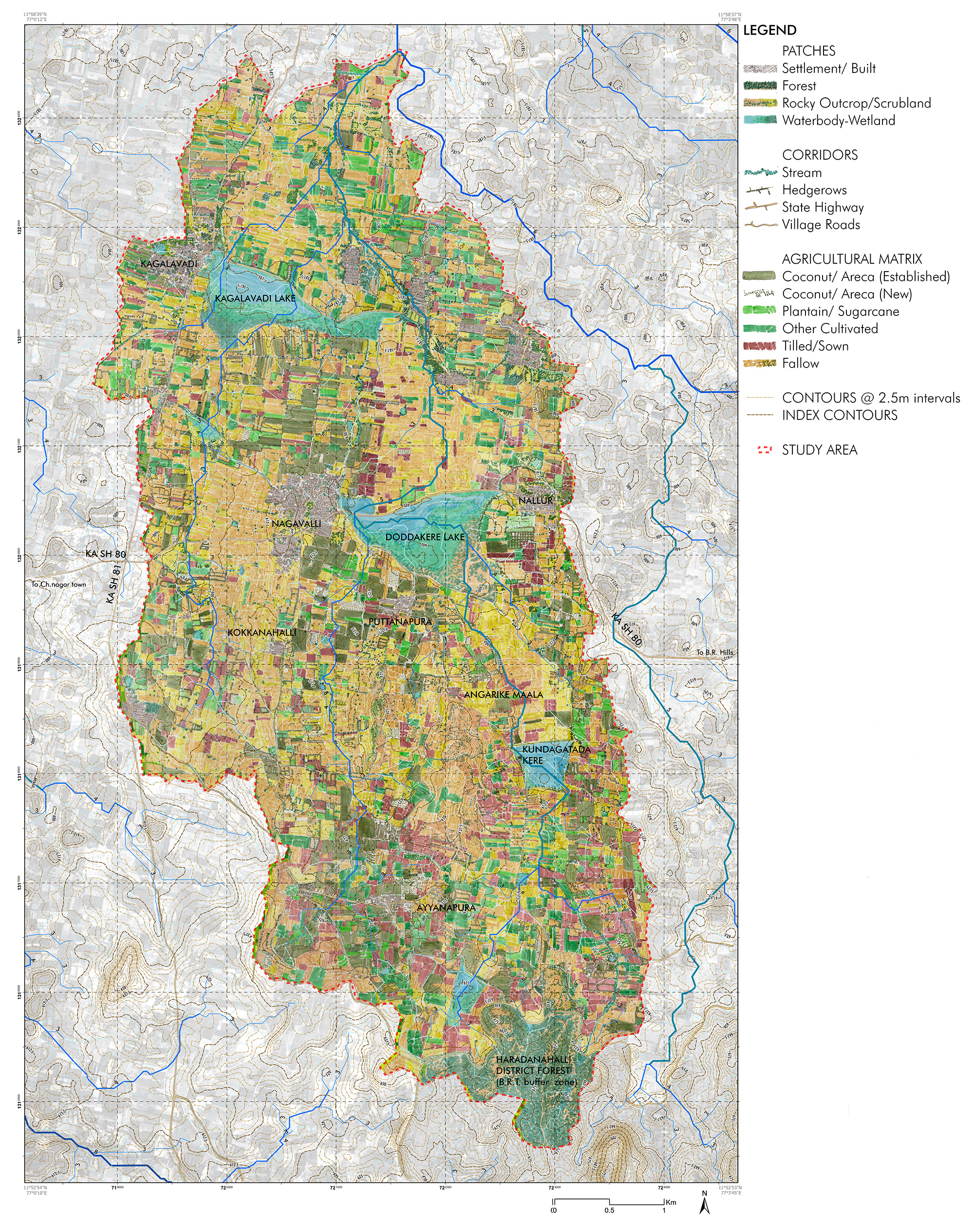
Mapping the Nagavalli Watershed Project (Sindhuja Sarasram) –
Sindhuja Sarasram conducted a study and developed her thesis on “‘CLIMATE-CHANGE ADAPTATION FOR AT-RISK DRYLAND RURAL LANDSCAPES THROUGH LANDSCAPE MANAGEMENT STRATEGIES: A Case of Nagavalli Village Environs, Chamarajanagar, Karnataka’ Masters in Landscape Graduation Project (2023), under the guidance of Saurabh Popli, School of Planning and Architecture, Bhopal.
This project looks at climate-change adaptation at the marginal farm scale through good farming practices and strategies for ‘Landscape Health’. Details from this study include the impact of human activities and its intertwining with climate change to degrade agricultural and rural landscapes. Details from this study will be drawn on to develop out-reach and awareness activities for the residents of Nagavalli and for training local youth as ‘climate change catalysts’.
2021-2022: Climate Change Video
Based on data, infographics, and a short film on people’s understandings of climate change, Ratheesh, Sharada and Shreekanth (as volunteers and friends of PUNARCHITH) have made a five-minute video on climate change in the district. We first released this video to a select audience or network of people in the district and then based on requests have shared this video after having English sub-titles added to the video.
2019: Farmers’ View on Climate Change